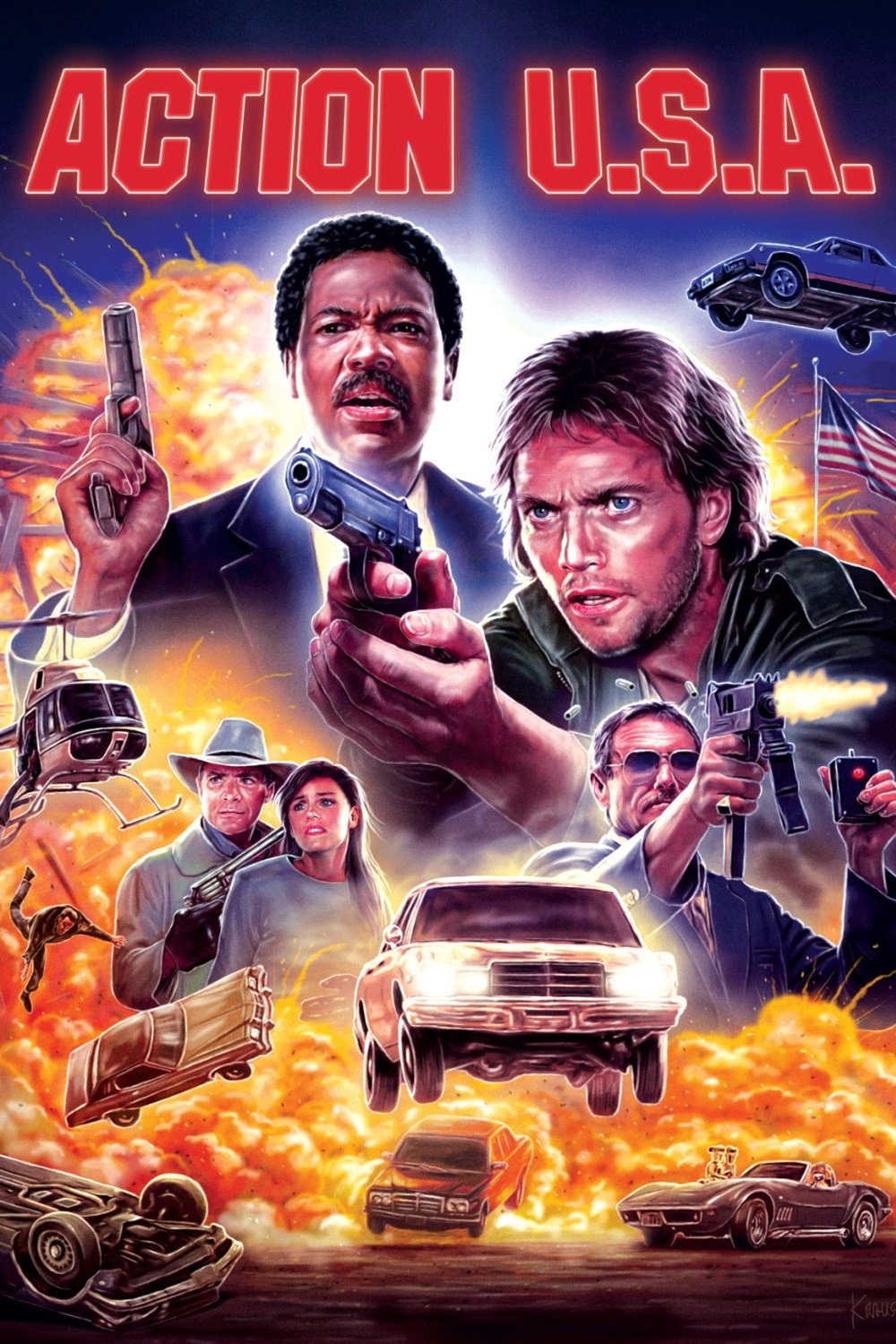
Written by William Hubbard Knight
Starring Barri Murphy, Gregory Scott Cummins, William Hubbard Knight, Ross Hagen
Why It's Overlooked
Action USA went directly to VHS in 1989, which means it bypassed every mechanism by which films achieve cultural recognition and went straight into the video store racks where it would spend its entire life being rented by thirteen-year-olds on Friday nights and returned on Saturday morning. There were no reviews. There was no theatrical run. There was no awards consideration. The film was produced outside the Hollywood system by a crew of Texas-based stunt professionals who had spent their careers crashing cars and blowing things up for other people's movies and who one day decided to make a film of their own — a film that would consist primarily of crashing cars and blowing things up, but in which they would have final cut.
The resulting film is, in the most precise possible sense, auteur cinema: a work that reflects completely the vision and obsessions of its creators, without compromise or interference from producers, studios, or market research. The auteurs in this case happen to be stunt professionals rather than artists in the conventional sense, and their vision involves more car crashes per reel than any film in recorded history, but the principle is the same. Action USA exists because the people who made it wanted to see exactly this film and had the skills to make it happen. The result is an artifact of pure, uncut, professionally executed action filmmaking that the critical apparatus of 1989 was not equipped to evaluate because the critical apparatus of 1989 was not paying attention to direct-to-video stunt spectacles from Texas.
The film's IMDb score of 5.8 tells you something important: it has been evaluated primarily by people who approached it as a conventional narrative film and found it wanting in the ways that conventional narrative films are evaluated — characterization, dialogue, thematic depth. These are not the right categories. Action USA should be evaluated as an action film in the same way that a sonnet should be evaluated as a sonnet: by whether it achieves what it sets out to achieve with the means available to it. By that standard, it is extraordinary.
What Makes It Great
The action sequences in Action USA are real. This is the first and most important thing to understand about the film, and it is something that contemporary audiences, conditioned by thirty years of CGI stunt replacement, may struggle to fully absorb. Cars actually crash. Buildings actually explode. Stunt performers actually perform the feats that the camera records. The film was made by people whose professional expertise was the safe execution of dangerous things, and they applied that expertise to their own production with the result that the film contains more genuine, unaugmented, physically accomplished action filmmaking than anything released by a major Hollywood studio in the same period at fifty times the budget.
There is a freedom to the filmmaking that only comes from complete autonomy and total commitment to a single goal. Director John Stewart and his crew knew exactly what they wanted — spectacular action, relentlessly paced — and had the skills to deliver it without the studio interference that would have demanded more story, more character, more time between explosions. The result is a film that functions like a greatest-hits compilation of stunt work: every few minutes something extraordinary happens, the camera is in the right position to capture it, and the editing presents it with a clarity that is instructive about how action films should work. It is not a subtle film. It is a film that does one thing with complete mastery, and one thing done with complete mastery is worth celebrating regardless of how many other things it does not do.
Who Should Watch It
Action USA is essential viewing for anyone who has watched a modern action blockbuster and thought, vaguely but persistently, that something is wrong — that the action feels weightless, that the physics are unconvincing, that the CGI stuntwork has replaced the visceral reality of bodies in danger with something that looks technically impressive but lands emotionally flat. This film is the antidote to that feeling: action so physically real that you feel it in your chest even on a television screen. It is also essential viewing for anyone interested in the history of American stunt work as an art form, because this is what stunt professionals do when you take the stars and the studio system out of the equation and let them work. The answer is: this. They make films that consist almost entirely of their expertise, presented with the clarity of people who understand exactly what they're showing you and why it's impressive. Come for the curiosity factor. Stay because it is surprisingly, instructively great at the thing it is doing.
Sonora Festival Context
At the 2024 Sonora Film Festival, Action USA took home Best Picture — tied with Hundreds of Beavers, in a result that required no tiebreaker, both films being exactly the kind of cinema the festival exists to celebrate — and earned the Most Overacting award for Drago, whose performance operates at a frequency entirely distinct from anything else in the film and possibly from anything else in cinema. The committee noted that Drago's commitment to theatrical extremity is so total and so precise that it functions as a kind of performance art operating inside an action movie, and that this is meant as high praise.
The festival selected Action USA as an argument about value and craft. The film is not great in the ways that prestige cinema is great. It does not have a searching screenplay or complex characters or thematic ambitions that reward close reading. What it has is mastery — the mastery of people who are extraordinarily good at a specific set of skills applying those skills to their own creative project without compromise. That is a legitimate form of greatness, and it has been consistently undervalued by a critical culture that treats craft divorced from conventional artistic ambition as mere competence. The Sonora Film Festival disagrees. Mastery is mastery. When you watch the car chases in Action USA, you are watching the absolute peak of a specific form of human skill. That deserves recognition.
We also want to note, for the record, that the film contains a scene in which a car explodes, and then another car explodes, and then a building explodes, and then a car explodes again, and the entire sequence is staged with such professional ease that you briefly wonder why all films are not like this before remembering that films like this require people who know how to do these things safely and cheaply, and those people are rarely given the keys. The 2024 Sonora Film Festival is glad that, in 1989, they were.
← Back to 2024 SelectionsSee Also
More from the 2024 Sonora Film Festival: