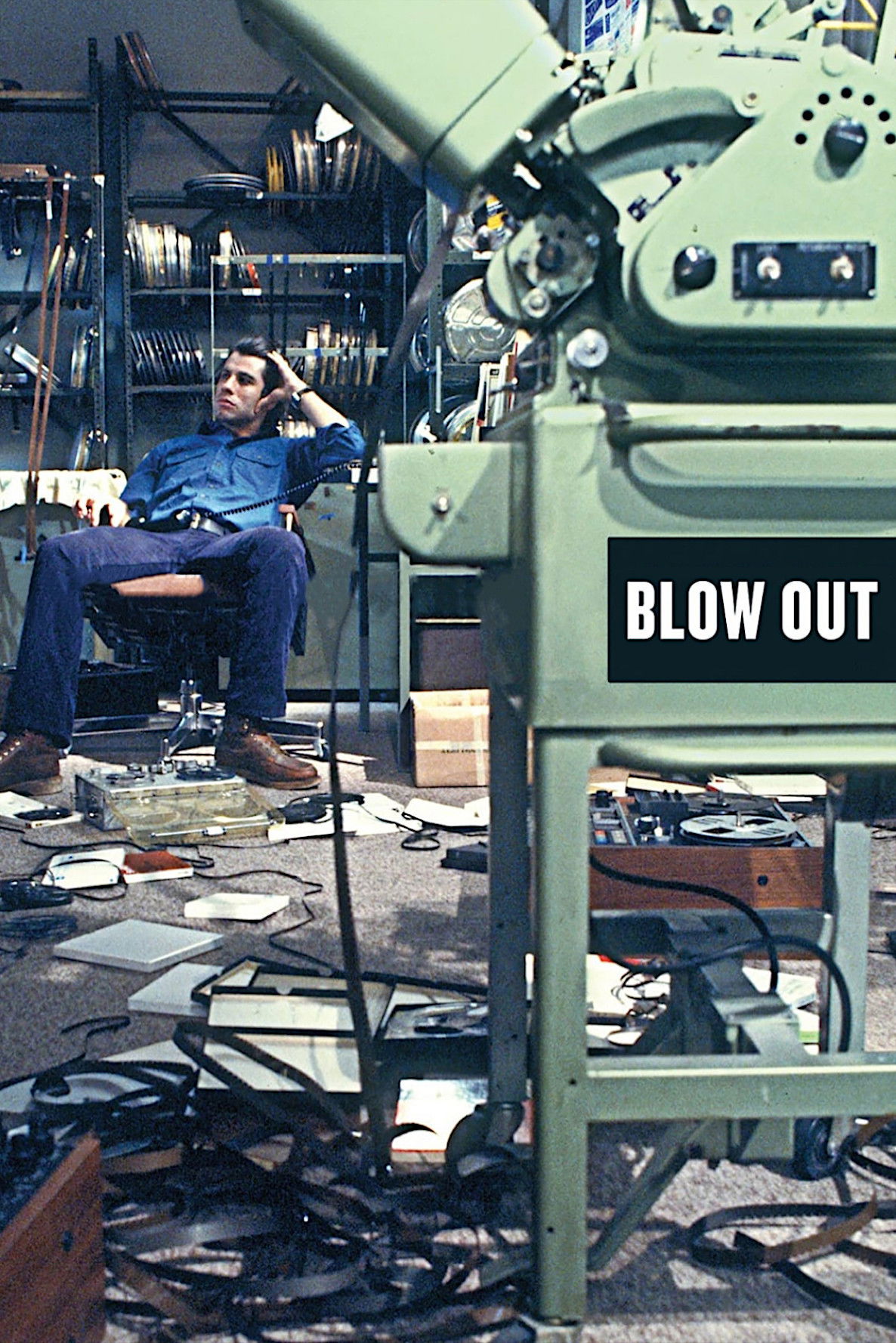
Written by Brian De Palma
Starring John Travolta, Nancy Allen, John Lithgow, Dennis Franz
Music by Pino Donaggio
Why It's Overlooked
Blow Out was released in the summer of 1981 to reviews that ranged from lukewarm to hostile, bombed at the box office, and has spent the forty-plus years since oscillating between "cult film" and "critics' discovery" without ever achieving the mainstream recognition that its stature demands. Part of the reason is timing: the film appeared at the nadir of John Travolta's post-Saturday Night Fever career slump, before his subsequent rehabilitation, and the cultural machinery that shapes reception had already decided that Travolta was a fading star rather than an actor of genuine range. A film that rests its entire emotional weight on a Travolta performance was easy to dismiss in 1981 in ways that it would not be today.
The deeper reason is Brian De Palma himself. De Palma's career has always suffered from a critical failure of nerve — reviewers who cannot quite bring themselves to say that a director working in the thriller genre is one of the great American filmmakers, regardless of how overwhelming the evidence becomes. Blow Out is De Palma at his most formally ambitious and his most emotionally exposed: a film about the inadequacy of recorded evidence, about the gap between what we can capture and what actually happened, about the particular American tragedy of being right about a conspiracy and unable to make anyone believe you. These are not the preoccupations of a genre craftsman. They are the preoccupations of a serious artist. The critical establishment of 1981 was not prepared to say so, and the film's reputation has been slowly, inadequately catching up ever since.
There is also the ending, which is one of the most devastating conclusions in American cinema and which many viewers, conditioned by genre conventions to expect resolution, initially found unacceptable. Blow Out ends in failure — complete, irreversible, formally perfect failure — and the way De Palma stages that failure, with Jack Terry using Sally Badina's dying scream as the sound effect for his exploitation horror film, is an act of cinematic cruelty so precisely calibrated that it feels like a thesis statement about the relationship between art, complicity, and the things we consume. Audiences in 1981 mostly walked out confused or angry. In retrospect, the ending is the key that unlocks everything the film is about.
What Makes It Great
John Travolta gives the performance of his career — including everything that came before and after — as Jack Terry, a movie sound effects man who accidentally records the sound of a tire blowout that turns out to be a gunshot, who saves a woman from a sinking car, and who then spends the film trying to prove that a presidential candidate was murdered while everyone around him, for reasons both sinister and banal, works to prevent that proof from reaching the light. The performance is built on a quality that Travolta rarely got to deploy in his career: genuine intellectual seriousness. Jack Terry is smart, technically expert, emotionally invested, and completely alone in a world that has decided to bury the truth he's uncovered. Travolta plays his isolation as a slow accumulation of grief, and by the film's end you feel the full weight of a man who did everything right and was destroyed anyway.
De Palma's direction is at its most virtuosic and most purposeful. The split-screen sequences — a technique De Palma often deploys for pure formal pleasure — here carry genuine emotional and narrative weight, the divided frame enacting the film's central thesis about the impossibility of unified knowledge. The tracking shots, the long takes, the baroque camera movements that are De Palma's signature: in Blow Out they feel not like display but like argument, formal choices that embody the film's ideas about surveillance, recording, and the inadequacy of evidence. Pino Donaggio's score, which in lesser De Palma films can tip toward melodrama, here achieves an urgency that feels tragic — music that mourns even before the catastrophe it is anticipating has arrived.
Who Should Watch It
Blow Out is essential viewing for anyone who believes that American cinema peaked in the 1970s and wants to see that peak extended into the following decade by its most formally gifted practitioner. If you love The Conversation — Francis Ford Coppola's 1974 masterpiece about a surveillance expert who records evidence of a murder — then Blow Out is its companion piece, a film that engages with the same material from a different angle and arrives at a considerably darker conclusion. Fans of De Palma who have seen Carrie, Dressed to Kill, or Scarface without yet reaching Blow Out need to correct that oversight immediately: this is the film that contains everything those films were reaching for. And for anyone who wants to see what John Travolta could do when given a director and a script that trusted him completely, this is the answer. It is a great American film that has been waiting, with extraordinary patience, for the audience it deserves.
Sonora Festival Context
At the 2024 Sonora Film Festival, Blow Out earned the award for Best Scene for the opening "movie within a movie" sequence — a sustained piece of De Palma showing exactly what the film understands about genre and its possibilities before the credits have finished — along with Worst Actor for Nancy Allen, an award the committee granted with full appreciation for the specific register of theatrical excess her performance achieves. The Sonora Film Festival wishes to note that Worst Actor, in this context, is a form of tribute.
The festival selected Blow Out as a corrective to one of American cinema's most persistent critical failures. De Palma has never received the retrospective canonization that his peers Scorsese, Coppola, and Spielberg have accumulated, despite producing a body of work that is, film for film, as consistently brilliant as any of theirs. Blow Out is the clearest evidence of that critical failure: a film that a generation of critics greeted with skepticism or indifference that has slowly, imperfectly revealed itself to be one of the genuine masterpieces of its decade. The Sonora Film Festival does not have the power to correct forty years of misdirected attention, but it can insist, at the appropriate volume, that the correction is overdue.
Jack Terry, at the end of the film, has his perfect scream. He has built his career around the search for authentic sound, and he has found it, and the finding of it has cost him everything. That paradox — the artist who achieves formal perfection through catastrophe — is De Palma's great subject, and Blow Out is where he explores it with the most unsparing honesty. The Sonora Film Festival recommends it without reservation and without apology for the state it will leave you in.
← Back to 2024 SelectionsSee Also
More from the 2024 Sonora Film Festival: