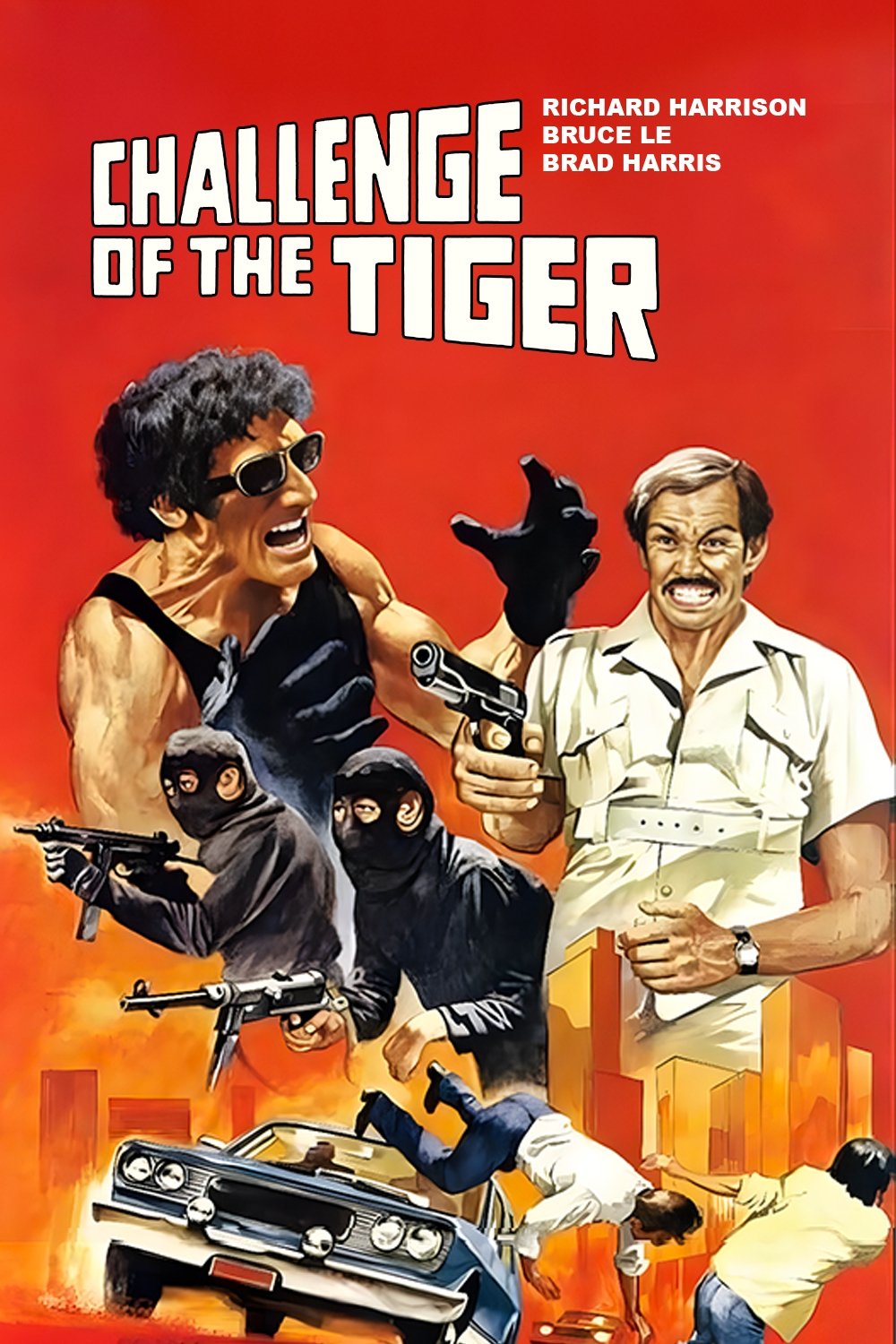
Starring Bruce Le, Richard Harrison, Hwang Jang Lee
Production IFD Films & Arts
Why It's Overlooked
Challenge of the Tiger occupies a specific and poorly understood corner of film history: the Bruceploitation era, in which Hong Kong studios responded to Bruce Lee's death in 1973 by producing dozens of films featuring Bruce Lee imitators with names designed to invoke the original — Bruce Le, Bruce Li, Dragon Lee, and many others. This genre has been systematically dismissed by film criticism, categorized as cynical exploitation rather than genuine creative enterprise, and largely forgotten outside of cult audiences who appreciate it for reasons critics have never quite been willing to engage with seriously. Challenge of the Tiger, directed by and starring Bruce Le himself, is one of the most fully realized examples of this form — and the form, understood on its own terms rather than judged against the standard of what it is not, is worthy of serious attention.
The Bruceploitation era produced films of extraordinary invention under severe constraints. Working with minimal budgets, compressed schedules, and the impossible task of filling a vacuum left by one of the most charismatic screen presences in cinema history, these filmmakers developed a set of conventions and a visual language that is as distinctive as any genre cinema has produced. The results are often rough, sometimes incoherent, and reliably spectacular in ways that no amount of polish could replicate. Challenge of the Tiger is all of these things simultaneously, and it deserves to be seen as the audacious, unhinged, deeply committed genre artifact that it is.
What Makes It Great
The tennis scene. We must begin with the tennis scene. Approximately midway through Challenge of the Tiger, there is a sequence in which Richard Harrison's American agent plays tennis — real tennis, on a real court — against a series of opponents, while the film appears to simultaneously be a spy thriller, a martial arts film, and something else entirely that no genre label has ever successfully described. The scene goes on for what feels like several geological epochs. It is beautiful. It achieves a kind of transcendence that only completely unself-conscious cinema can produce — a sequence so committed to its own logic, so utterly indifferent to any external standard of what a scene like this is "supposed" to be, that it becomes something close to art by accident.
The fights are the other reason to watch. Hwang Jang Lee, one of the great unsung physical performers in martial arts cinema, brings a technical ferocity to his villainous role that sharpens every scene he's in. His kicks are among the fastest and most powerful ever captured on film, and the choreography around him — rough and occasionally incoherent by the standards of polished Hong Kong action cinema, but electrifying in its rawness — has an energy that more technically accomplished films often lack. Bruce Le himself is a skilled performer, and his chemistry with Harrison provides the film's unlikely emotional center: a buddy action dynamic that is both absurd and oddly endearing.
What Challenge of the Tiger understands, at some level that may or may not have been entirely conscious, is that the pleasure of action cinema is not primarily about coherence. It is about commitment — the absolute conviction with which performers and filmmakers throw themselves into the spectacle. This film has that conviction in excess, and it is infectious.
Who Should Watch It
Challenge of the Tiger is for the adventurous viewer who wants to understand the full history of martial arts cinema — not just its celebrated peaks but the strange, fertile, genre-defining middle period that produced so much of the visual vocabulary the form still uses today. It is for cult cinema enthusiasts who understand that films can be interesting and imperfect at the same time, and that the imperfections are sometimes where the most interesting things happen. And it is, frankly, for anyone who wants to watch some of the fastest kicks ever put on film in a context so magnificently bizarre that the experience is simply unlike anything else. The tennis scene alone is worth the runtime.
Sonora Festival Context
The Sonora Film Festival has always had an affection for films that operate at the fringes of mainstream taste — not because marginality is inherently interesting, but because the margins are often where genuine creative energy accumulates when the center becomes too comfortable with its own standards. Challenge of the Tiger is a quintessential example: a film that the institutions of film culture have never known what to do with, made by people who were not operating within those institutions and did not particularly need their approval.
The 2025 jury selected Challenge of the Tiger in the spirit of genuine appreciation for what it accomplishes on its own terms, awarding it Best Surprise/Reveal for the tennis match sequence, Most Provocative Use of a Prop for the Child Peeing Statue, and The Weng Weng Award for Excellence, shared with Ip Man. This is not ironic enjoyment. This is the real thing: a film that produces genuine kinetic pleasure, genuine spectacle, and one absolutely transcendent sequence involving a tennis court that must be seen to be believed. The Sonora Film Festival exists to champion films the mainstream has mishandled. Challenge of the Tiger was mishandled before it even had a chance. We are correcting the record.
← Back to 2025 SelectionsSee Also
More from the 2025 Sonora Film Festival: