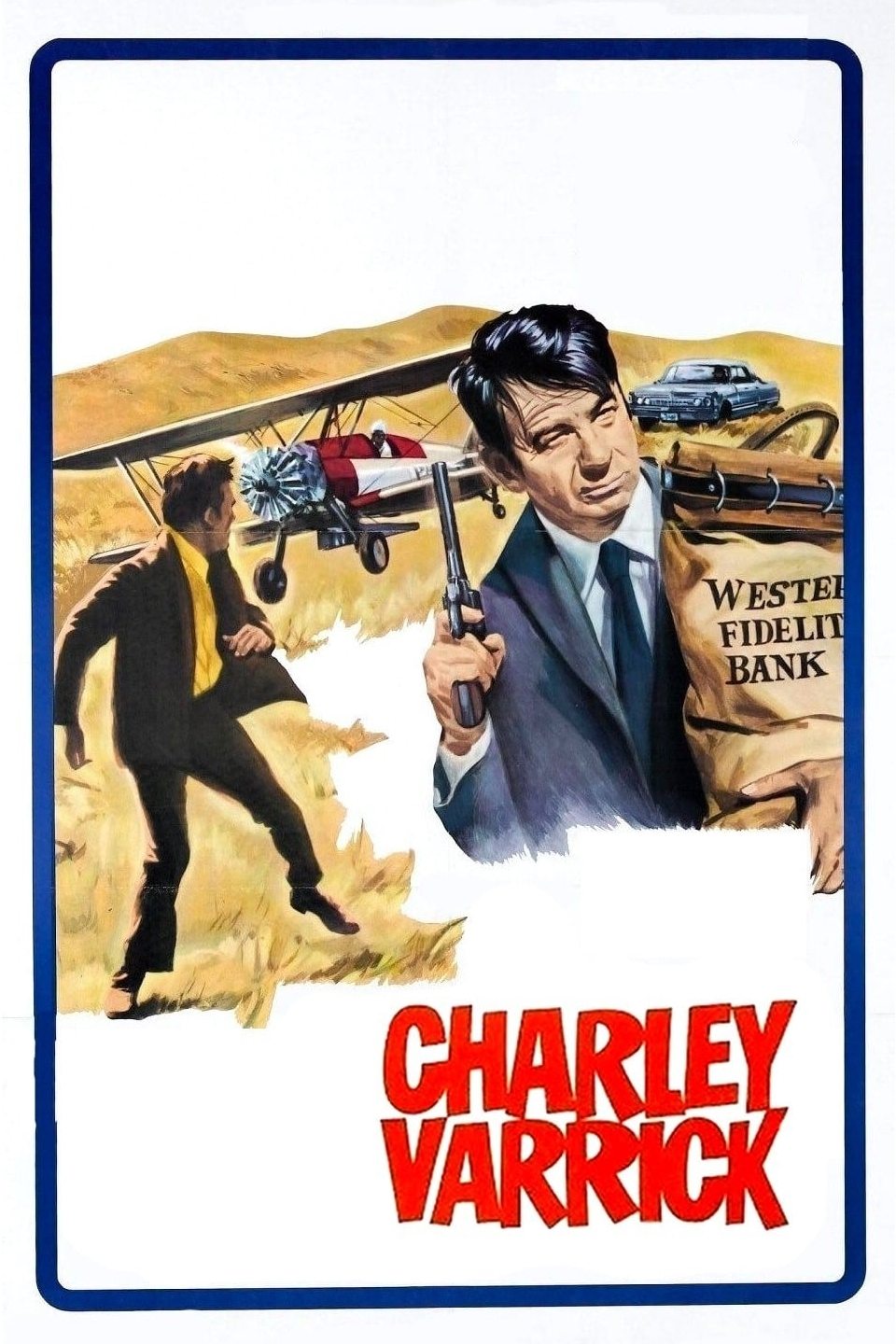
Screenplay by Howard Rodman & Dean Riesner
Starring Walter Matthau, Joe Don Baker, Felicia Farr, Andy Robinson
Music by Lalo Schifrin
Why It's Overlooked
Charley Varrick arrived at an extraordinary moment in American cinema — 1973, the year of The Exorcist, The Sting, and Badlands — and promptly got buried. Universal mishandled its marketing, positioning it as a routine action picture when it was something far more precise and subversive. Critics of the era, still dazzled by the operatic violence of Peckinpah and the stylistic fireworks of the New Hollywood vanguard, largely filed it under "competent genre entertainment" and moved on. And Walter Matthau — brilliant, rumpled, unmistakably himself — didn't fit the mold of a 1970s action hero. Nobody was putting him on a poster with a gun and calling it cool. The result was a film that made a modest profit, earned a few approving notices, and then vanished into the television syndication circuit where it has spent the last half-century being discovered by night owls and dismissed as a forgotten curio.
The oversight is staggering because Charley Varrick is, by almost any measure, a better film than the crime pictures that overshadowed it. Don Siegel had already directed Dirty Harry two years earlier, and where that film operates on the adrenaline of moral ambiguity, Charley Varrick runs on something colder and more satisfying: pure intelligence. It is a film about a man who is simply smarter than everyone around him — the police, the mob, his own crew — and who treats every setback as a problem to be solved with the methodical calm of an engineer. That kind of protagonist, brainy rather than brash, has never been fashionable. Hollywood prefers its heroes loud. Varrick wins by thinking, and American cinema has never quite known what to do with that.
Part of the problem is that the film refuses easy categorization. It is not quite a heist film — the heist happens in the first ten minutes, almost as a formality. It is not quite a chase film, though there is pursuit. It is not a revenge picture. It is, at its core, a film about preparation: about a man who has spent his entire life thinking three steps ahead and who applies that habit to the most dangerous situation of his life. That kind of intellectual thriller has a small but devoted audience, and Hollywood has never found a reliable way to sell it to the mainstream. Charley Varrick fell between the categories and paid the price.
What Makes It Great
Walter Matthau gives one of the great undervalued performances in American cinema. He plays Charley Varrick with a quality that is almost impossible to describe and even harder to fake: the absolute convincingness of a man who is always, at every moment, the smartest person in the room, and who has the discipline to never let that show. Matthau's Varrick is laconic, observant, perpetually a beat ahead of the audience — you watch him watch other people and understand that he is already calculating their next three moves. It is a performance of extraordinary restraint in a decade that worshipped excess, and it has aged better than almost anything from that era. His scene with John Vernon's corrupt banker, in which Varrick quietly explains the consequences of cooperation versus resistance, is a masterclass in using stillness as threat.
Against Matthau, Joe Don Baker's Molly — the mob's enforcer sent to retrieve the stolen money and eliminate anyone who touched it — functions as the film's dark mirror. Where Varrick is cerebral and controlled, Molly is physical and inexorable: less a character than a force of nature, methodically working through the list of people who need to die. The tension between these two figures, the thinking man and the killing machine, drives the film with the precision of a well-maintained engine. Siegel, at the peak of his craft, stages their inevitable confrontation with an economy of means that makes the sequence feel both inevitable and surprising. And Lalo Schifrin's score — spare, jazz-inflected, full of watchful silences — reinforces every beat of the psychological chess match without ever overstating it.
Who Should Watch It
Charley Varrick is essential viewing for anyone who has grown tired of action films where the hero wins through violence alone and longs for something that makes them lean forward and actually think. If you love the cool procedural precision of Michael Mann, or the genre intelligence of the Coen Brothers at their most deadpan — think No Country for Old Men or Blood Simple — then this is a direct ancestor worth knowing. Fans of classic neo-noir who have exhausted Chinatown and Point Blank will find here a film that belongs in exactly that company. And for anyone who believes Walter Matthau was primarily a comedian, this film will reconfigure your understanding of what that actor was capable of when handed a role that demanded more than charm. It is a cool, smart, supremely confident piece of genre filmmaking, and it has been waiting patiently for fifty years to find the audience it deserves.
Sonora Festival Context
At the 2024 Sonora Film Festival, Charley Varrick took home the award for Best Surprise/Reveal — citing multiple scenes, including Matthau bedding Miss Fort and Molly's sudden accent, a reveal so well-constructed that the committee described it as feeling both inevitable and impossible simultaneously — along with Most Reckless Disregard for Human Life and Public Property, Most Politically Incorrect Moment, Worst Movie (tied with Dark Angel), and Worst FX for the film's screeching tires, which the committee awarded with enormous affection for a sound effect that appears to have been recorded in conditions no committee member could satisfactorily explain.
The awards recognized what the festival has always championed: films that trust their audience to keep up. Charley Varrick never explains itself, never condescends, never slows down to make sure you've caught every implication. It assumes you are watching closely and rewards that attention with a plot so precisely constructed that the final act feels both unexpected and completely inevitable on reflection. That combination — genuine surprise plus retrospective inevitability — is the highest achievement of the thriller form, and Charley Varrick accomplishes it with a modesty that makes it look easy. It is not easy. It is the product of a master director working at the peak of his craft with a cast that understood exactly what they were making.
The Sonora Film Festival selected this film because it represents the precise type of work the festival exists to honor: a movie that is not merely good but definitionally overlooked, whose obscurity is a failure of distribution and cultural attention rather than a reflection of its quality. Don Siegel made it at seventy-one years of age with the confidence of a director who had nothing left to prove and everything left to say. That it has spent fifty years being treated as a footnote is a cultural wrong the festival is happy to help correct.
← Back to 2024 SelectionsSee Also
More from the 2024 Sonora Film Festival: