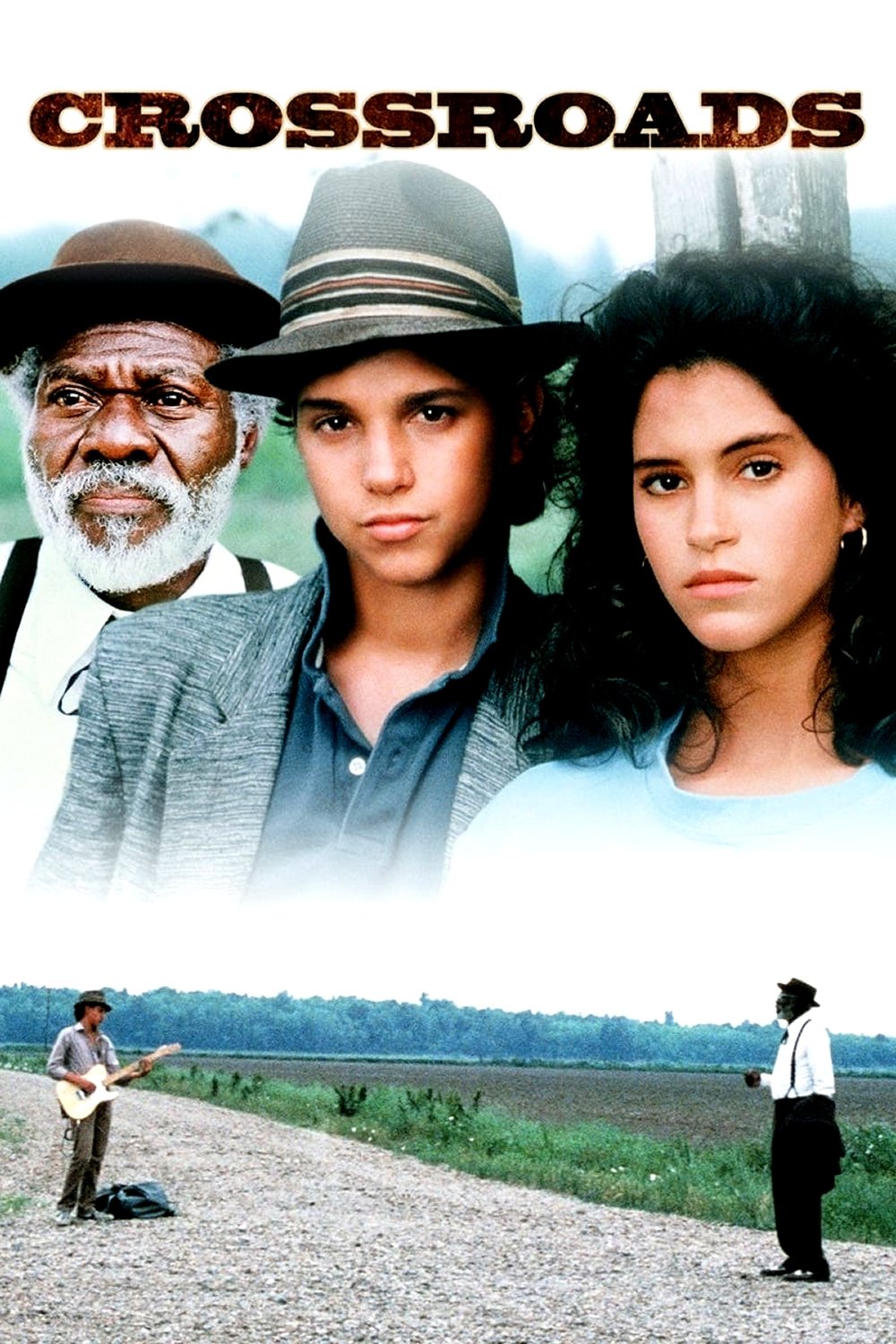
Screenplay by John Fusco
Starring Ralph Macchio, Joe Seneca, Jami Gertz, Steve Vai
Music by Ry Cooder
Why It's Overlooked
Crossroads arrived in March 1986, and the timing could not have been worse or the marketing more willfully obtuse. Here was a film about the Delta blues — about Robert Johnson, the Faustian mythology of the Mississippi crossroads, and the price of talent extracted in blood — and its primary selling point was that it starred the kid from The Karate Kid. The posters gave you Ralph Macchio in a leather jacket. The trailers promised a teen movie with a rock soundtrack. What you actually got was a brooding, melancholic road film with one of the most authentic blues scores ever written for a Hollywood production, anchored by Joe Seneca's towering performance as a man who sold his soul and spent sixty years paying for it.
The film was not a hit. Critics were confused by its genre — too serious to be a crowd-pleaser, too genre-inflected to be prestige drama — and audiences who came hoping for more Karate Kid energy left disappointed. What they missed was a accomplished piece of American mythology-making, directed by Walter Hill (who had already given the world The Warriors and 48 Hrs.) with the kind of lean, economical craft that was becoming unfashionable as the decade exploded into excess. Crossroads is a quiet film about a loud music. That paradox was too strange for 1986, and it has never quite found the general audience it deserves.
Its cult following is real but scattered. Guitar enthusiasts know it, blues obsessives revere it, and anyone who stayed through the closing credits of the final duel has carried it with them ever since. But it rarely appears on best-of lists, rarely gets theatrical revivals, and remains stubbornly underrepresented in any serious conversation about American music films. For a movie this good, that's a genuine cultural failure.
What Makes It Great
The engine of Crossroads is the relationship between Eugene Martone (Ralph Macchio), a Juilliard student who has devoted himself to mastering the Delta blues, and Willie Brown (Joe Seneca), an elderly harmonica player and genuine relic of the Robert Johnson era who has been rotting in a nursing home for decades with a secret: he knows the location of Johnson's lost thirtieth song. Eugene springs him, and they head south toward the Mississippi Delta and the reckoning Willie has been avoiding for most of his life.
Joe Seneca is the film's beating heart and its greatest achievement. Willie Brown is not a warm mentor figure. He is cantankerous, evasive, occasionally cruel, and haunted by a deal he made at a crossroads in the 1930s that he has spent every subsequent year trying to survive. Seneca plays this with complete conviction — the performance has the weight of lived experience, the kind of self-possession that cannot be faked. His rapport with Macchio is affecting, the dynamic between a young musician who wants to possess the blues and an old man who knows what the blues actually costs.
And then there is Ry Cooder's score, which may be the finest work he ever did for a film. The music is not atmospheric wallpaper — it is a full argument for what the blues means and why it matters, played with a fidelity to tradition that never tips into pastiche. Every slide guitar phrase feels earned, every bottleneck run feels like testimony. The score is a film within the film.
Finally: the guitar duel. In the climax, Eugene must defeat Jack Butler (Steve Vai), the Devil's own guitarist, in a battle that is simultaneously absurd and entirely, deliriously effective. Vai plays it with the appropriate combination of reptilian menace and superhuman technique. Macchio's performance is a masterclass in physical commitment — his fingering is accurate, his body language is completely sold, and when he pivots from rock pyrotechnics to a fragment of classical counterpoint to win the contest, the film lands the moment it has been building toward for an hour and a half. It is one of the most satisfying climaxes in the history of the genre film. Full stop.
Who Should Watch It
Crossroads is essential viewing for anyone who loves American music and wants to see it treated with genuine seriousness on screen. If you care about the blues — its history, its mythology, its relationship to the Faustian bargain at the heart of so much American creative ambition — this film gives you that mythology rendered with real care and real feeling. If you are a guitarist of any stripe, the final duel will be one of the most galvanizing sequences you have ever seen: the specific pleasure of watching technique deployed in high stakes combat, where the difference between winning and losing is whether you can find one line of music more true than anything your opponent can throw at you.
For fans of Walter Hill, Crossroads is an underappreciated gem in a career full of them — proof that the director who made The Warriors could also make something tender without softening his lean, no-nonsense craft. And for anyone who dismissed it in 1986 because the marketing made it look like a teen movie, the film is ready to surprise you. It is, at its core, a film about what it means to truly love an art form — and about what you owe the people who gave it to you.
Sonora Festival Context
At the 2022 Sonora Film Festival, Crossroads punched well above its cult-favorite status and walked away with three awards, more than any film except RRR. Willie Brown's dialogue — sardonic, direct, epigrammatic, containing decades of hard-won wisdom in every throwaway line — earned Best Quote, the award going simply to "any time he talks." The guitar bar duel, with its escalating stakes, its specific geography, and its final pivot into classical counterpoint, won Best Location. And Steve Vai, who performs Jack Butler as a being of pure malevolent technique, won Most Overacting in a category he did not so much win as monopolize.
The Most Overacting award deserves a word of defense on Vai's behalf: what he does in Crossroads is not bad acting. It is precisely calibrated theatrical excess — a performance pitched to the film's mythological register, in which the antagonist needs to feel supernatural. Butler isn't a character in a realistic drama; he is the Devil's own instrument, and Vai plays him with the kind of smirking, otherworldly menace the role demands. Calling it overacting is accurate; calling it a flaw would be missing the point entirely. In the context of a film about Faustian bargains and the supernatural origins of the blues, Vai's performance is exactly right.
The festival committee selected Crossroads because it is exactly the kind of film Sonora exists to champion: a work of genuine craft and feeling that fell between the cracks of its own marketing, got misread by critics who didn't know which genre pigeonhole to put it in, and spent the subsequent decades being rediscovered slowly, one guitar player at a time. Willie Brown would recognize the situation. He spent sixty years waiting for the right person to appreciate what he knew. The festival is happy to be that person.
← Back to 2022 SelectionsSee Also
More from the 2022 Sonora Film Festival: