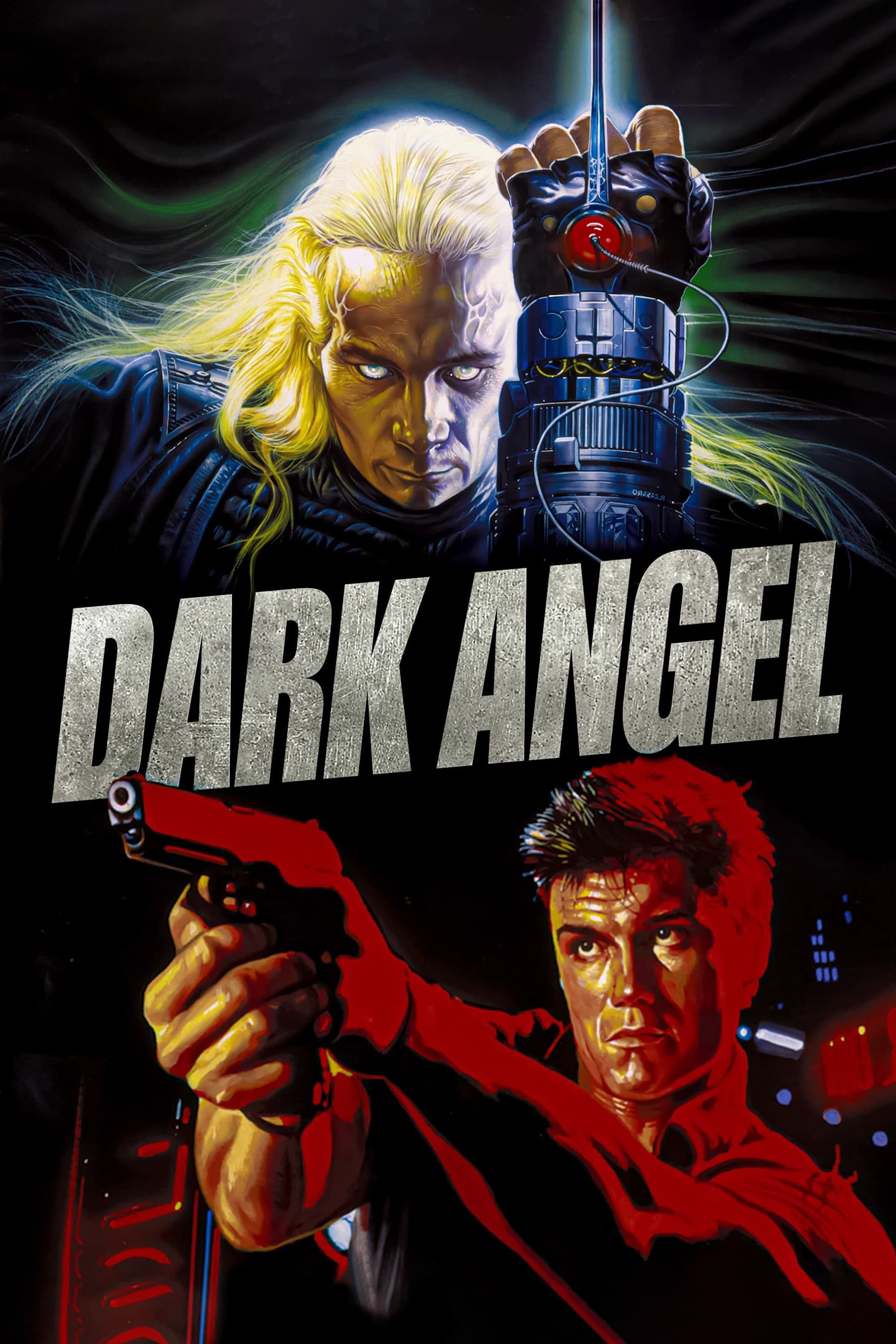
Screenplay by Jonathan Tydor & Leonard Maas Jr.
Starring Dolph Lundgren, Brian Benben, Betsy Brantley, Matthias Hues
Music by Jan Hammer
Why It's Overlooked
Dark Angel — released in the United Kingdom under the title I Come in Peace, which is both more memorable and considerably more accurate — is the kind of film that the critical establishment of 1990 was structurally incapable of appreciating. It is a B-movie that takes itself completely seriously, executes its absurd premise with professional conviction, and delivers action sequences of genuine technical quality — and the critical apparatus of that era had no vocabulary for praising a film that existed proudly below the prestige line. Reviews were brief, dismissive, or nonexistent. The film earned a modest theatrical run, moved quickly to home video, and spent the next thirty years being discovered by late-night cable viewers who couldn't believe what they were watching.
The specific nature of the film's obscurity is instructive. It is not that Dark Angel failed to find its audience; it is that its audience never developed the critical infrastructure to advocate for it. The people who love this film love it with genuine passion, but the language of genre enthusiasm — "it's so good because it's so committed," "the craft is invisible because it's so efficient" — doesn't translate well into the critical discourse that shapes cultural memory. The film has a 6.2 on IMDb from a relatively small pool of voters, which tells you nothing about its quality and everything about how thoroughly it fell through the cracks of the home-video era. A film this enjoyable, this well-made, this committed to its own magnificently strange premise should have ten times those votes. That it doesn't is a distribution failure, not an aesthetic judgment.
There is also the Dolph Lundgren problem. After Rocky IV and Masters of the Universe, Lundgren was positioned in the public imagination as a novelty act — the big blond guy who looks like a sculpture and speaks in that accent. What that positioning missed was that Lundgren is, within the frame of the films that suit him, an unusually effective screen presence: physically convincing, possessed of genuine deadpan comic timing, and capable of carrying action sequences with a controlled physicality that most of his contemporaries couldn't match. Dark Angel understood this perfectly and built the film around his strengths. The mainstream never revised its assessment. The loss is the mainstream's.
What Makes It Great
Craig R. Baxley came to directing from a career as a stunt coordinator and second-unit action director, and Dark Angel reflects that background in every frame. The film is exceptionally well-staged — the action sequences are coherent, spatially clear, and satisfyingly escalating, the kind of craft that becomes invisible because it simply works. The alien antagonist (Matthias Hues, who stands six foot five and moves with the fluid economy of a predator who has never been threatened by anything on this or any other planet) is one of the more unsettling villains of late-80s genre cinema: alien enough to be wrong, physical enough to be dangerous, and equipped with a CD-launching weapon that turns music distribution into lethal artillery in ways that feel both absurd and somehow inevitable.
The film's secret weapon is Brian Benben as Arwood "Rat" Smith, the by-the-book FBI agent paired with Lundgren's Jack Caine. Where lesser films would make this pairing purely antagonistic, Dark Angel allows the relationship to develop genuine warmth — Benben's exasperation is funny, but Baxley never lets the comedy undercut the stakes. The result is a buddy picture with an actual buddy at its center, two men who come to respect each other while dealing with the most professionally unusual assignment in the history of law enforcement. Jan Hammer's synthesizer score, which would sound dated in a lesser film, here serves as the perfect sonic register for a story that is simultaneously a straightforward action thriller and a cheerfully gonzo piece of science fiction. The film knows exactly what it is, commits to it completely, and earns its pleasures honestly.
Who Should Watch It
Dark Angel is essential viewing for anyone who has ever argued that genre films deserve the same critical respect as prestige pictures, because this is exactly the kind of genre film that argument was invented for. It delivers on its promises with professional precision, wrings genuine tension from a premise that could easily tip into camp, and contains at least three action sequences that belong in any serious conversation about the craft of filmed violence. Fans of late-80s action cinema will find here one of the form's unremarked peaks — better staged than much of what was dominating the multiplex at the time, and considerably more entertaining than its reputation suggests. And anyone who has ever watched Dolph Lundgren onscreen and felt a vague sense that he was better than his material was right: this is the material that fits. Come for the alien with the CD launcher. Stay because the film is, against all reasonable expectations, great.
Sonora Festival Context
At the 2024 Sonora Film Festival, Dark Angel took home the award for Best Quote — the committee unanimous on the scene in which a detective asks "What university did you graduate from?" and receives the answer "The university of suck my dick," an exchange that encapsulates the film's particular mixture of genre commitment and inspired lunacy — along with Most Chuck Norris-like Performance for Dolph Lundgren, and Worst Movie, tied with Charley Varrick, a distinction the committee wishes to note was granted with deep affection for a film that knows exactly what it is.
The festival selected Dark Angel because it represents a category of overlooked film that the mainstream is particularly bad at recovering: the genre picture that was simply too good at its job to be celebrated in its time. Critics in 1990 were not equipped to praise a film for being an exceptionally well-made sci-fi action thriller, because the critical establishment had not yet developed the framework for treating genre competence as a legitimate artistic achievement. The film paid the price for that critical failure and spent three decades being rediscovered by individuals rather than championed by institutions. The 2024 Sonora Film Festival is happy to serve as one such institution.
The alien says "I come in peace." He does not come in peace. Dolph Lundgren says "and you go in pieces." He does not elaborate further. This exchange is, in miniature, everything the film understands about itself: the perfect deployment of a terrible pun in service of a genuine cinematic moment. That level of self-aware craft is the signature of filmmakers who love the genre they're working in. Dark Angel is a love letter to action cinema written by people who knew exactly what they were doing. The Sonora Film Festival is proud to have been the occasion for its rediscovery.
← Back to 2024 SelectionsSee Also
More from the 2024 Sonora Film Festival: