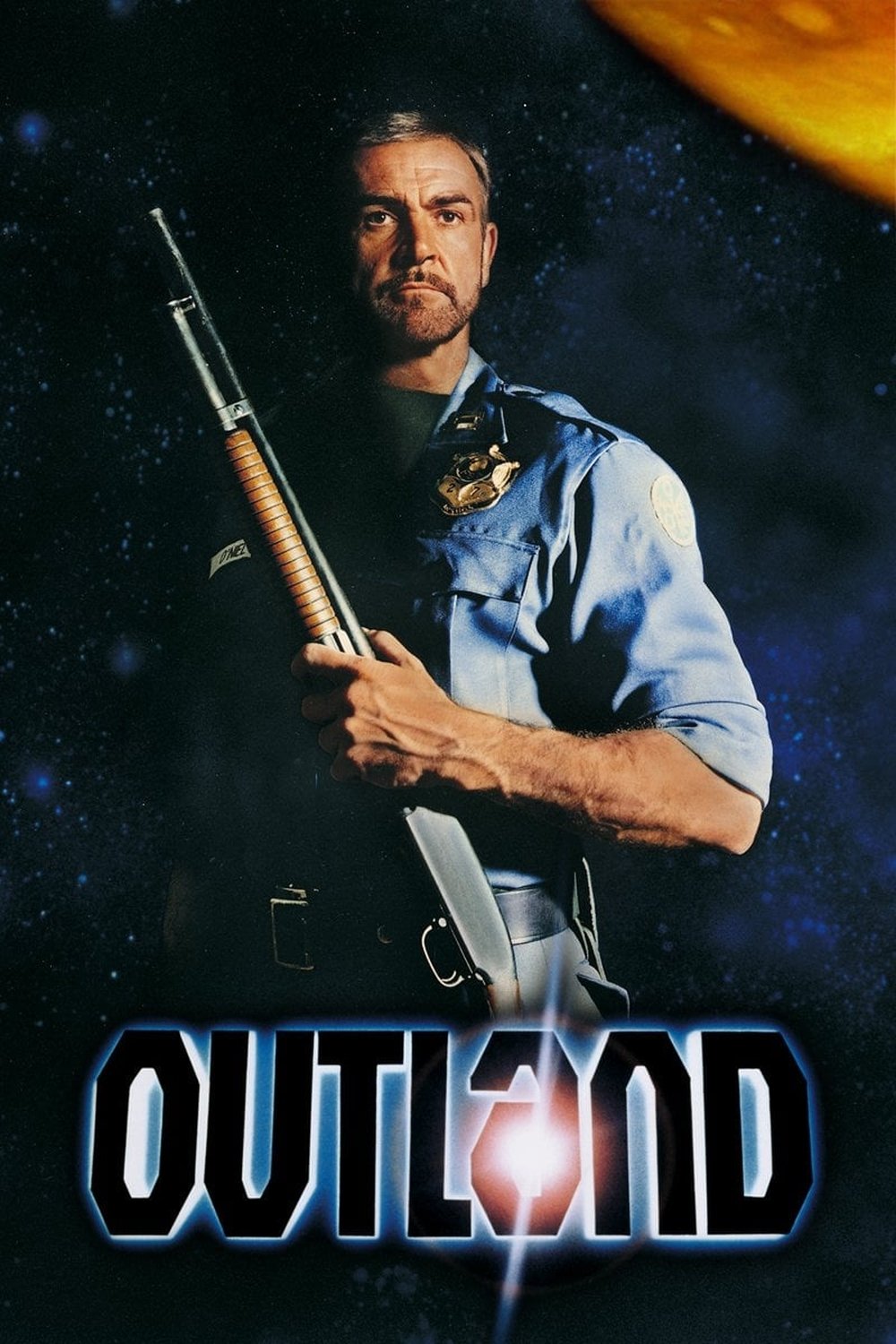
Written by Peter Hyams
Starring Sean Connery, Peter Boyle, Frances Sternhagen
Cinematography by Stephen Goldblatt
Why It's Overlooked
Outland arrived in May 1981 sandwiched between the cultural tidal wave of the first Indiana Jones film and the lingering afterglow of The Empire Strikes Back, which had redefined popular expectations for science fiction the previous year. A methodical, grimy, deeply adult thriller about corporate malfeasance and one man's stubborn refusal to look the other way — set on a mining colony on Io rather than in a galaxy far, far away — had no chance of capturing the cultural imagination in that climate. Critics called it derivative, noting the obvious debt to High Noon that Peter Hyams acknowledged openly. Audiences were looking for wonder and got suspense instead. The film performed adequately at the box office and then retreated into a comfortable obscurity that it has never fully escaped.
The other factor working against Outland's legacy is its relationship to Sean Connery's career trajectory. In 1981, Connery was between James Bond and his late-career renaissance — The Name of the Rose (1986), The Untouchables (1987), and his eventual Oscar win were still years away. He was perceived by critics and studios as a star in comfortable decline, coasting on residual charisma rather than making meaningful choices. That perception was wrong, and Outland is evidence of why it was wrong: Connery's performance here is one of his finest, a study in quiet, contained determination that asks far more of him than the Bond films ever did. But in 1981, nobody was looking for a career reassessment. The film was filed and forgotten.
What Makes It Great
Outland is, at its core, a film about institutional corruption and the particular loneliness of being the one person who refuses to participate. Federal Marshal William T. O'Niel (Connery) arrives at Con-Am 27, a titanium mining colony on Io, to find a community so thoroughly corrupted by the drug trade that his determination to investigate the rash of miner suicides and psychotic breaks makes him a target rather than a protector. The film's true antagonist is not Peter Boyle's smoothly menacing general manager, but the system he represents — the quiet, efficient logic of looking away when looking away is profitable. Hyams builds this world with extraordinary physical specificity: the colony's corridors are claustrophobic and industrial, the lighting is harsh and fluorescent, and the constant awareness of the vacuum just outside the walls gives the film a low-grade existential dread that no amount of action choreography could manufacture.
Connery's O'Niel is magnificent precisely because he is not a superhero. He is tired, slightly past his prime, recently abandoned by a wife who finally ran out of patience with his principled stubbornness. When the killers are dispatched from Earth and the countdown to their arrival begins, O'Niel's fear is palpable and genuine — he is not certain he will survive, and neither are we. Frances Sternhagen, as the colony's sardonic and ultimately heroic doctor, provides the film's comic spine and its emotional ballast simultaneously: her pragmatic cynicism slowly curdling into something resembling admiration is the film's most quietly moving arc. Together, Connery and Sternhagen create one of action cinema's great odd-couple partnerships — not romantic, not sentimental, but built on mutual respect earned through shared danger.
Who Should Watch It
Outland is required viewing for anyone who loves classic westerns and has ever wondered what the genre could look like refracted through the prism of late-1970s science fiction production design. The film answers that question definitively. Fans of gritty, grounded science fiction — the audience for Alien, Blade Runner, and their contemporary descendants — will find in Outland a kindred spirit: a film more interested in the texture of working-class labor and institutional rot than in spaceships and spectacle. And for Sean Connery completists, the film is essential: it is the performance that showed what he was capable of when liberated from the tuxedo, and it deserves the same attention his more celebrated later work receives.
Sonora Festival Context
The 2023 Sonora Film Festival selected Outland because it represents a particular category of cinematic injustice: the film that was dismissed not because it failed to accomplish what it set out to do, but because what it set out to do was too modest for the cultural moment in which it arrived. Outland is a supremely competent, deeply felt thriller that does exactly what it promises. Its ambitions are not world-historical. It does not aspire to mythology. It wants, simply, to be a rigorous, tense, adult genre picture — and it achieves that goal with such quiet authority that the achievement has been almost entirely overlooked.
Audience response was enthusiastic and slightly surprised — the surprise that comes from discovering that a film you had vaguely heard of and never prioritized turns out to be excellent. The film took home Best Scene for the exploding head, Best Location for the sets and miniatures, Most Chuck Norris-like Performance for Connery's work as a man who simply will not back down, and Most Provocative Use of a Prop for the unlimited shotguns, a category in which the competition was strong but the winner was never in doubt. Several audience members noted that Connery's performance here felt more committed and more emotionally available than anything he did in the Bond films, and that the film's central predicament — one honest man facing down a corrupt system that wants him dead — lands with particular force in the present day. The Sonora Film Festival submits that Outland deserves a place in the conversation about great science fiction cinema of the 1980s, and that its exclusion from that conversation says more about critical fashion than cinematic merit.
← Back to 2023 SelectionsSee Also
More from the 2023 Sonora Film Festival: