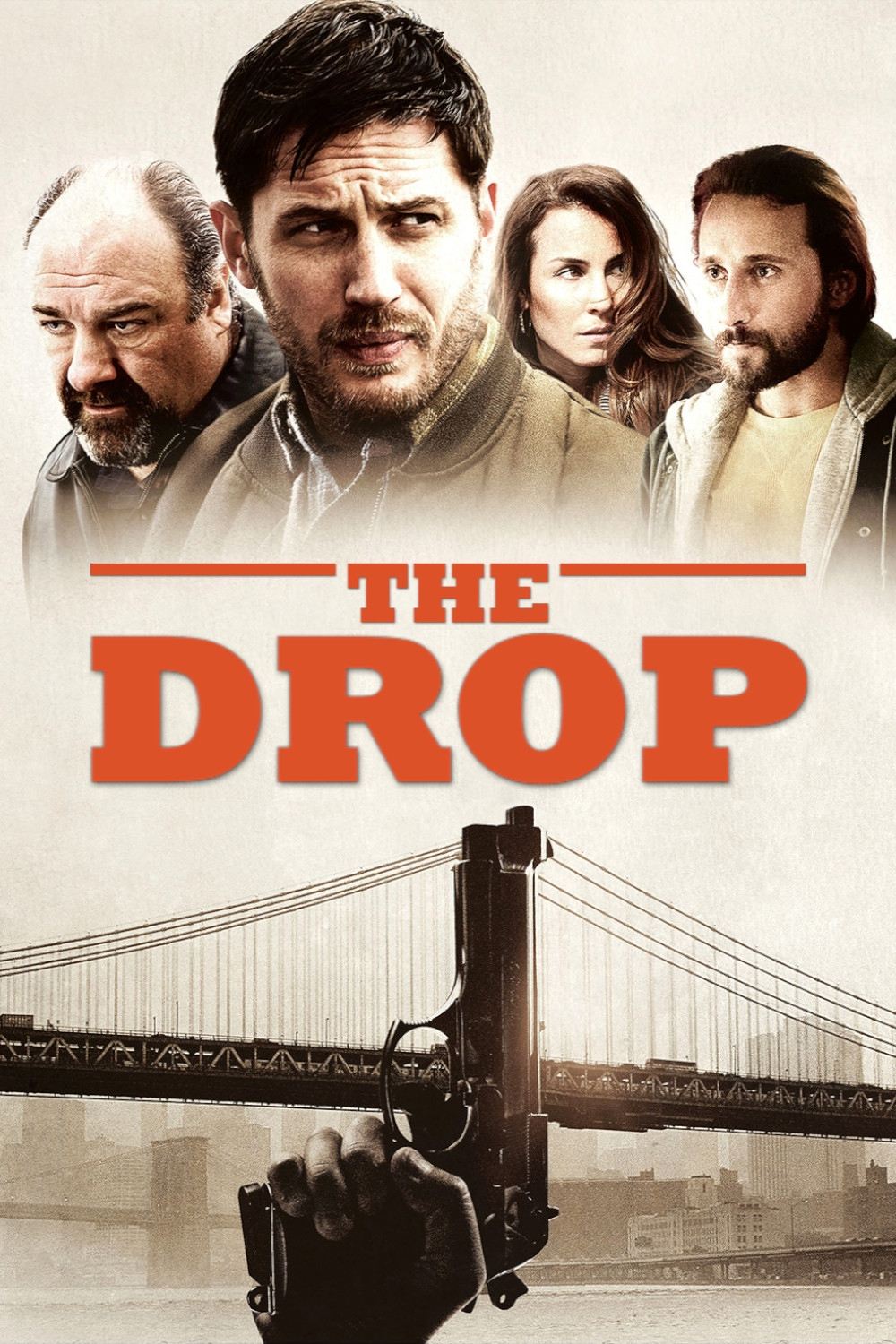
Screenplay by Dennis Lehane (based on his story "Animal Rescue")
Starring Tom Hardy, James Gandolfini, Noomi Rapace, Matthias Schoenaerts
Music by Marco Beltrami & Buck Sanders
Why It's Overlooked
The Drop opened in September 2014, played to strong reviews, and then essentially vanished. This is the peculiar fate of the mid-budget crime film in the modern studio system: the critics admire it, the audience that catches it tends to love it, and then it drifts off into the streaming catalog never to be discussed again. The film has no franchise potential, no sequel hooks, no four-quadrant accessibility. It is, at its core, a character study about a quiet Brooklyn bartender who may or may not be a deeply dangerous man — and that is precisely the kind of film that contemporary distribution systems have no mechanism for sustaining in the cultural conversation.
There is also the shadow of James Gandolfini, who died in June 2013 while the film was in post-production. His presence in The Drop is extraordinary, and the film functions in part as a final performance — a farewell to the specific strain of working-class menace and pathos that he perfected over a career that culminated in The Sopranos. But films that carry this kind of weight often get framed primarily as memorials rather than as works of art on their own terms, and The Drop suffered from that distortion. It was treated as a footnote to a career rather than a film worth evaluating independently.
Most criminally, Tom Hardy's performance here — among the finest he has ever given — tends to get overshadowed by his more physically extravagant work in Mad Max: Fury Road, Bronson, and the Venom films. Bob Saginowski requires a completely different kind of acting: interior, withholding, constructed almost entirely from silence and carefully managed stillness. It is the kind of performance that looks like nothing is happening until suddenly everything is happening, and mainstream awards conversations rarely know how to reward that.
What Makes It Great
The genius of The Drop is in its construction of Bob Saginowski as a man whose depth is measured by what he does not say. Bob tends bar at Cousin Marv's, a Brooklyn neighborhood joint that the Chechen mob uses as a money drop — a location where the evening's illicit proceeds are temporarily stored before being moved. Bob is placid, devout, apparently simple. He goes to Mass, he cares for a stray pit bull puppy he finds in a garbage can, he speaks in short sentences and does not look for trouble. The film spends most of its runtime asking whether the gentleness is the whole man or merely the surface of something else entirely.
Dennis Lehane's screenplay, adapted from his own short story, is a masterpiece of compression. Every scene carries information on multiple levels simultaneously — what is said, what is not said, what the saying of one thing conceals about another thing entirely. Roskam, a Belgian director making his American debut after the remarkable Bullhead, brings an outsider's precision to the material: he sees the milieu clearly, without sentimentality or the neighborhood romanticization that afflicts so many American crime films. The result is a film that feels simultaneously specific — this neighborhood, these people, this world — and universal in its examination of guilt, complicity, and the moral accounting we do or fail to do for what we have been.
James Gandolfini's Cousin Marv is the film's other great performance. Marv was once the neighborhood tough, the man everyone feared, and is now a diminished figure running a bar that belongs to other people, nursing grievances and resentments in equal measure. Gandolfini plays this with a generosity that never tips into self-pity — Marv is aware of his own diminishment, and that awareness has curdled into something both sad and dangerous. It is a quieter performance than Tony Soprano, which is precisely what makes it, in some ways, more devastating. And the final image we have of Gandolfini on screen carries the weight of a valediction.
Who Should Watch It
The Drop is essential for anyone who loves character-driven crime fiction — readers of Dennis Lehane, Elmore Leonard, and James Ellroy will recognize immediately the specific register this film is operating in, and will appreciate how faithfully Roskam and Lehane have translated it to the screen. Fans of Tom Hardy who have only seen his more physically theatrical work will find here a performance that reveals the full range of what he can do when given the space for restraint. And for anyone who believes that the mid-budget American crime film is a dying art form, this movie is one of the clearest arguments that the art form is not dying — it is simply being underseen.
Go in knowing as little as possible. The film's climax works precisely because the screenplay has spent ninety minutes carefully managing what you know and what you only suspect about Bob Saginowski. The less you know going in, the more completely the final sequence will land. If you have already been told what happens, the film still rewards: you watch it the second time in a state of differently calibrated dread, catching every note of foreshadowing Roskam and Hardy planted in scenes you thought you understood.
Sonora Festival Context
At the 2022 Sonora Film Festival, The Drop won Best Surprise/Reveal for the moment the festival committee christened "Bob Breaks Bad" — the scene in which everything we have been led to believe about Bob Saginowski is confirmed, reconfigured, and made both more terrible and more coherent simultaneously. The award is well-earned. Roskam builds to the moment with such patience, and Hardy executes it with such precision, that the reveal functions as a genuine shock even for viewers who had been suspecting its content for the preceding hour.
The committee noted that the reveal works on two levels that most films only achieve one of: it is surprising in the moment, and it retroactively deepens every preceding scene rather than contradicting it. Good reveals do one of these things. Great reveals do both. The Drop does both, which is a reflection of how carefully Lehane constructed the screenplay and how completely Hardy inhabited a character whose surface is an argument about what surfaces conceal.
The film was selected for the 2022 festival as a corrective to the crime genre's tendency to reward spectacle over character. The Drop has no car chases, no gun battles, no set pieces designed to generate trailer footage. What it has is a dog, a dead man's apartment, a bar where bad money passes through, and two of the finest performances in a year full of them. That was more than enough.
← Back to 2022 SelectionsSee Also
More from the 2022 Sonora Film Festival: