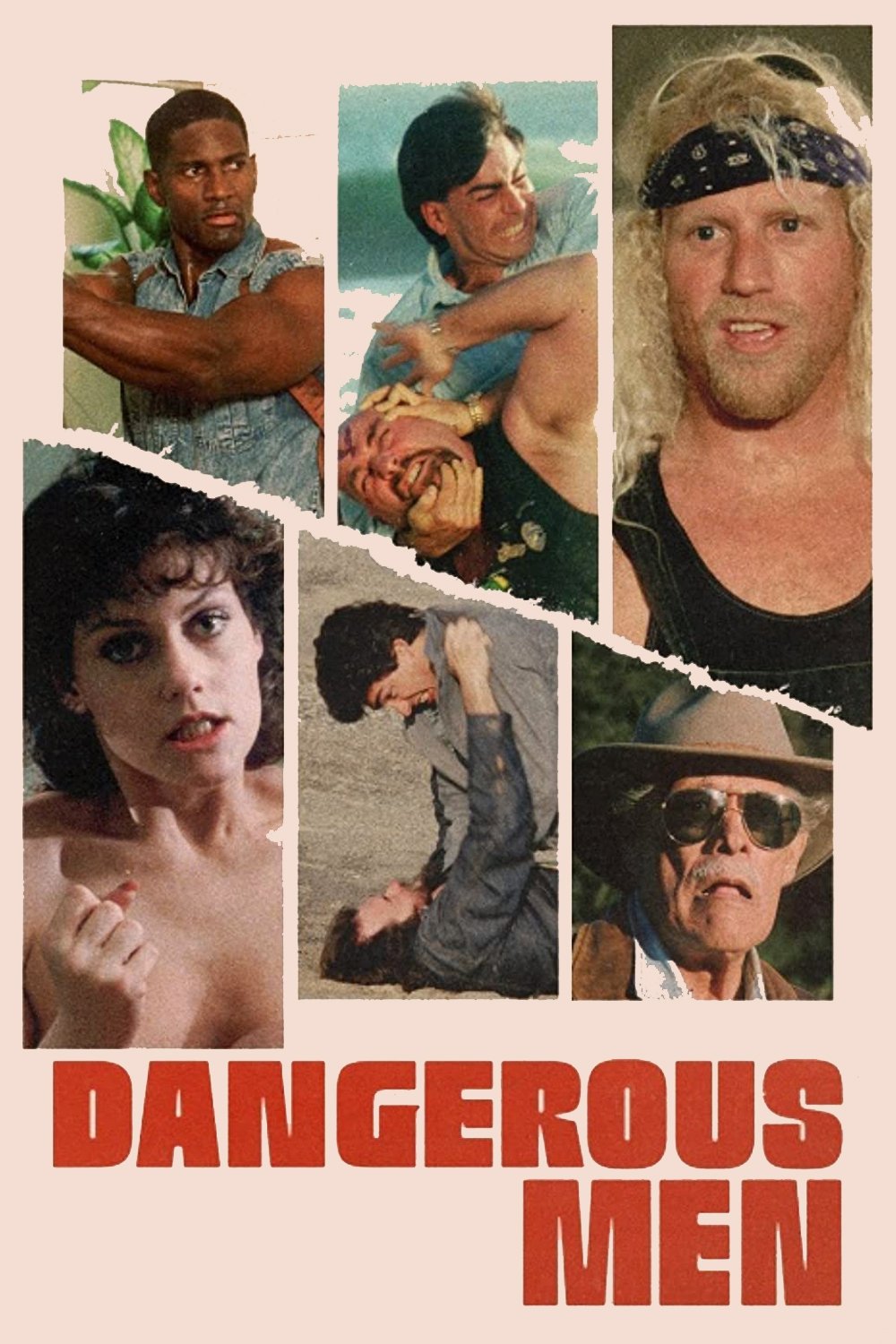
Starring Melody Wiggins, Michael Gradilone, Coti Cooper
A film assembled across three decades by one man
Why It's Overlooked
Dangerous Men was overlooked because, for most of its existence, it barely existed at all. The Iranian-American filmmaker John S. Rad — born Jahangir Salehi Yeganehrad — began shooting his revenge epic in the late 1970s and did not release it until 2005, financing and refilming and re-editing it across nearly thirty years as cars, fashions, hairstyles, and even his own cast members visibly changed mid-narrative. When it finally premiered, Rad four-walled it himself into a handful of Los Angeles theaters for a single week. It vanished almost immediately. There was no distributor, no marketing, no festival run, no review apparatus prepared to even categorize what had just happened. The film simply slipped beneath the surface of cinema and disappeared.
That should have been the end of it. Instead, a decade later, the American Genre Film Archive and Drafthouse Films rescued Dangerous Men from total obscurity and gave it the theatrical re-release Rad never lived to see — he had died in 2007, convinced he had made a masterpiece. He was, in his own way, correct. But the machinery of "serious" film culture has no shelf for a movie like this: it is too sincere to be dismissed as camp, too strange to be praised as competent, too singular to be filed alongside anything else. Critics who prize polish and coherence had no vocabulary for a work whose every frame radiates the unfiltered vision of a single human being answering to no one. And so it remained a rumor, a midnight whisper, a film more talked about than seen.
Its overlooked status says nothing about its power and everything about our discomfort with the genuinely unclassifiable. Dangerous Men is what happens when an artist is utterly, gloriously unconcerned with how movies are supposed to be made.
What Makes It Great
The plot of Dangerous Men is less a narrative than a relay race in which the baton is repeatedly dropped and picked up by a stranger. It opens as the story of Mina, a woman who watches her fiancé murdered on a beach and vows revenge on predatory men everywhere. Then, without warning or ceremony, the film abandons her to follow a detective. Then it abandons him to follow a desert-dwelling crime lord named Black Pepper. Characters are introduced with great gravity and then forgotten entirely. Subplots open and never close. And yet the film never once doubts itself — it proceeds with the serene, total confidence of a man who knows exactly the movie he is making, even when no one else can.
What makes Dangerous Men genuinely great, rather than merely strange, is its absolute purity of authorship. Rad wrote it, directed it, produced it, edited it, and composed its unforgettable synthesizer score, an electronic dreamscape that throbs beneath every scene with a hypnotic sincerity no studio would ever permit. There is not a single committee-smoothed edge anywhere in the film. Every baffling cut, every line of impossible dialogue, every abandoned plot thread is the direct and unmediated expression of one person's imagination. In an era of focus-grouped, algorithm-shaped cinema, that kind of unguarded artistic autonomy is almost extinct. To watch Dangerous Men is to watch a mind, wholly uncompromised, projected onto a screen. It is outsider art of the highest order — the cinematic equivalent of the Watts Towers, built alone, by hand, over decades, because the maker simply could not stop.
Who Should Watch It
Dangerous Men is essential viewing for anyone who believes cinema is at its most alive when it is least predictable. If you have ever loved the fearless wrong-footedness of The Room, the homemade conviction of Miami Connection, or the deranged sincerity of Neil Breen, you are already fluent in the language Rad is speaking — but Dangerous Men sits at the summit of that tradition, purer and stranger than any of them. It rewards the viewer who can surrender the demand that a film "make sense" and instead receive it as an experience, a fever, a transmission from a sensibility unlike any other. Watch it with a crowd if you can: it is a film that builds a room full of strangers into a single astonished organism. And watch it with respect, because beneath every laugh is the unmistakable fact that a man gave thirty years of his life to put this in front of you.
Sonora Festival Context
Dangerous Men opens the 2026 Sonora Film Festival — The Cage Edition, a placement the programming committee defends with unusual passion. The festival devoted this year to Nicolas Cage on the principle that true cinematic greatness is a matter of unrepeatable individual conviction, of an artist committing so completely to a vision that imitation becomes impossible. John S. Rad never met that brief on purpose; he simply lived it. There is no Cage in Dangerous Men, and yet the film embodies the festival's thesis more completely than almost any movie ever made: it is the work of an unrepeatable individual, fully committed, apologizing to no one.
We program it as Opening Night because it sets the terms for everything that follows. The Sonora Film Festival exists to find the films that the mainstream mishandled, undersold, or never knew how to see at all, and to give them the audience they always deserved. Dangerous Men is the festival's mission distilled to its essence — a film that was buried twice, refused to stay buried, and emerged as a genuine outsider masterpiece. Twenty-six years to make. Seventy-nine minutes to change how you think about what a movie can be. Begin here.
← Back to 2026 ProgrammeSee Also
More from the 2026 Sonora Film Festival — the Nicolas Cage Edition: