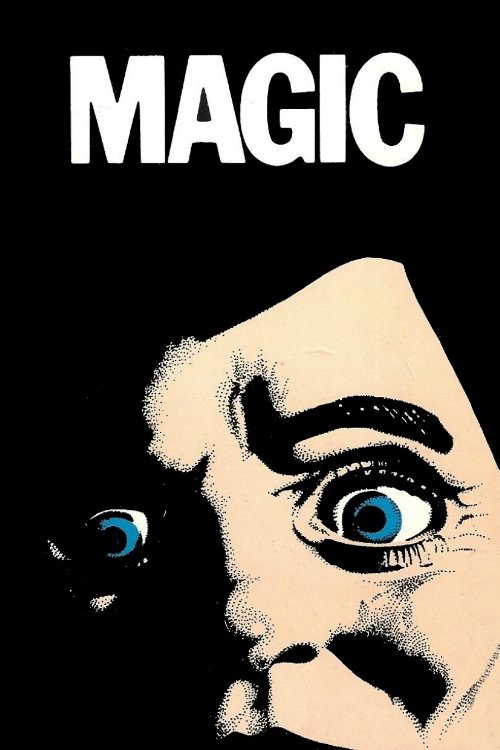
Written by William Goldman
Starring Anthony Hopkins, Ann-Margret, Burgess Meredith, Ed Lauter
Music by Jerry Goldsmith
Why It's Overlooked
Magic assembled a roster of talent that should have made it a permanent fixture of the canon, and instead it slipped quietly out of the conversation almost entirely. Directed by Richard Attenborough — soon to win Best Director and Best Picture for Gandhi — written by William Goldman at the height of his powers, scored by Jerry Goldsmith, and starring a not-yet-famous Anthony Hopkins, the film had every credential of a classic. But it arrived at an awkward seam in horror history: too psychological and character-driven for the slasher boom that Halloween ignited that very same season, yet too unnerving and macabre to be embraced as a prestige drama. It fell into the gap between two audiences and was claimed by neither.
What lingered, in the absence of the film itself, was its legendary marketing campaign — a teaser featuring the dummy reciting a singsong rhyme so genuinely disturbing it was reportedly pulled from television. For many people, Magic survives only as a half-remembered nightmare from a commercial break, a piece of folklore detached from the accomplished, deeply sad, and frightening movie that earned it. That is a particular kind of overlooked: a film remembered for thirty seconds of advertising and forgotten for its two genuinely masterful hours. Its neglect says nothing about its quality and everything about the bad timing and worse luck that can swallow even a film made by giants.
What Makes It Great
Magic is, above all, a showcase for one of the great early performances of Anthony Hopkins's career — and arguably the secret blueprint for the controlled menace that would later make him an icon. As Corky, a failed magician who finds sudden fame as a ventriloquist only to lose himself inside his foul-mouthed dummy, Fats, Hopkins performs a harrowing duet with himself: tender and broken as the man, vicious and domineering as the dummy, the line between them dissolving scene by scene until we can no longer tell who is speaking. It is a portrait of a disintegrating mind so precise and so empathetic that the horror never feels cheap — Corky is not a monster but a deeply wounded man being consumed from within, and Hopkins makes us mourn him even as we fear what he is becoming.
Attenborough, far better known for sweeping humanist epics, reveals here a remarkable gift for intimate dread. He stages much of the film as a chamber piece in a Catskills lakeside cabin, where Corky retreats to woo Peggy Ann (Ann-Margret, warm and quietly devastating), his high-school crush, and the claustrophobic stillness becomes unbearable. William Goldman's screenplay — adapted from his own novel — is a model of psychological economy, refusing easy supernatural answers and keeping the true horror located firmly in the human mind. And Burgess Meredith, as Corky's bullish agent, delivers a single interrogation scene — demanding Corky make Fats stay silent for five minutes — that ranks among the most quietly terrifying sequences of 1970s cinema. It is filmmaking of immense control, where the scares come not from shocks but from watching a soul come apart.
Who Should Watch It
Magic is essential viewing for anyone who prizes horror built on character and psychology rather than spectacle. If you are drawn to the slow-burn dread of Don't Look Now, the doomed intimacy of The Shining, or the long tradition of sinister-dummy tales it perfected, this is a foundational text — and the unmistakable ancestor of every "evil ventriloquist" story that followed. It is required viewing for admirers of Anthony Hopkins, offering a chance to watch the architecture of his most famous menace being drafted more than a decade before The Silence of the Lambs. And it rewards anyone who believes the most frightening monster is a human being losing the war for his own mind. Watch it late, watch it quiet, and do not look too long at the dummy.
Sonora Festival Context
Magic closes the 2026 Sonora Film Festival — The Cage Edition, screening Sunday as our Closing Night selection. The committee is aware that a 1978 ventriloquist thriller starring Anthony Hopkins is an unusual capstone for a programme otherwise devoted to Nicolas Cage, and we offer no defense beyond the festival's founding principle: greatness is greatness, and the best closing film is the one you cannot stop thinking about on the drive home. Magic is that film. It also stands as a quiet thesis statement — proof that the unhinged, fully committed performance the festival celebrates in Cage has a long and noble lineage, here rendered in a register of devastating restraint.
The Sonora Film Festival exists to rescue the films the culture mishandled, undersold, and allowed to fade, and to return them to the audience that deserves them. Magic — buried by bad timing, remembered only for a banned commercial, made by a Best Director, a master screenwriter, and a future legend — is exactly the kind of film the festival was built to resurrect. Leave the lights on for the drive back through the mountains. You will want them.
← Back to 2026 ProgrammeSee Also
More from the 2026 Sonora Film Festival — the Nicolas Cage Edition: